Stop Wasting Ad Spend: The Blueprint for Google Ads Landing Pages That Convert
Sending Google Ads traffic to your homepage is burning your budget. Team Kimes Design breaks down the copy-first architecture, multi-section conversion blueprint, and launch checklist for landing pages that turn high-intent clicks into revenue.
You have finalized your budget, dialed in your keyword strategy, and crafted compelling ad copy. Your Google Ads campaign is live. But if you are sending that hard-earned traffic directly to your homepage, you are bleeding leads and lighting your budget on fire.
At Team Kimes Design, we witness this exact mistake constantly. Business owners pour immense resources into setting up search campaigns, only to dump visitors onto a generic website homepage. A homepage is designed for exploration; it introduces your company, offers general background, and lists multiple service categories.
However, search traffic behaves differently. When a user queries a highly targeted phrase on Google and clicks your ad, they exhibit high buying intent. They don't want an exploration session—they want an immediate, specific solution.
To help you stop wasting ad spend, we have codified our internal strategy into a definitive guide. Here is how to engineer Google Ads landing pages that capture cold intent and transform it into revenue.

1. The Golden Rules of Landing Page Architecture
Before moving pixels around a screen, you must align your framework with fundamental conversion principles. These rules govern how search traffic interacts with your brand:
Write Copy First, Design Second: Never begin your creative process with wireframes. Finalize your written content first. Your words dictate the layout, the psychological flow, and the necessary structure of the page—not the other way around.
Eliminate All Escape Routes: Strip away your main website header navigation and your standard, link-heavy footer. Your landing page must serve a singular purpose. If you give users five options to browse other sections of your site, they will leave without converting. Clean up the header to contain only your logo and perhaps an immediate contact option.
Enforce No-Index Protocols: A high-converting paid landing page features an aggressive, direct pitch. If an organic user seeking educational content stumbles onto it, it may feel off-putting. Keep these ecosystems separate. Add a noindex tag to your page header so search engines never index your ad pages organically.
Isolate and Segment Category Intent: If you run an e-commerce platform selling greeting cards, do not drop searchers onto a generic catalog. If they search for "Independence Day E-Cards," your ad must point to a page explicitly dedicated to Independence Day cards, showcasing relevant seasonal inventory immediately.
The Core Psychological Shift: A website homepage provides context for building broad brand familiarity. A Google Ads landing page capitalizes on urgent, existing demand. Treat your search traffic like an active buyer walking through a storefront looking for a precise item.
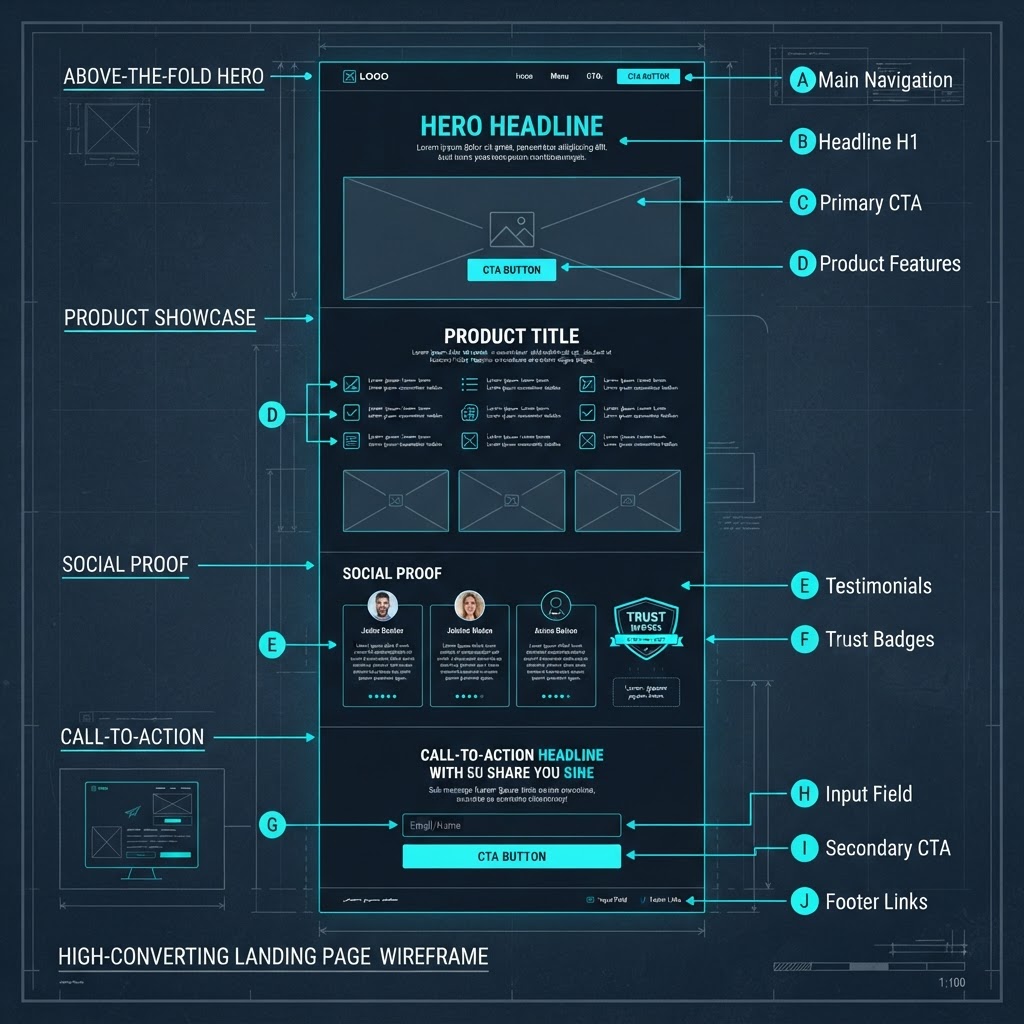
2. The Multi-Section Conversion Blueprint
Every successful paid landing page we deploy follows a strict vertical hierarchy. This structure guides a cold visitor seamlessly from awareness to action:
Section 1: Above the Fold (Immediate Resonance)
This space must hook your visitor instantly. It requires a bold, hyper-specific headline that mirrors the exact keyword phrase the user searched. Follow it with a clear subheadline clarifying your unique value proposition. Place a high-contrast primary Call-to-Action (CTA) button (e.g., "Buy Now," "Claim Your Offer") alongside a high-quality visual mockup or video sample.
Section 2: The Showcase (Tangible Demonstration)
Show your product or service in action. If you sell digital greeting cards, embed 5 distinct, high-quality visual samples or interactive previews right here. Accompany these assets with clear, bulleted benefits highlighting exactly what the buyer receives and how easily they can deploy it.
Section 3: Trust Validation (Social Proof Integration)
Cold paid traffic is inherently skeptical. Neutralize doubt by embedding prominent customer reviews, star ratings, verifiable testimonials, or partner logos immediately after your product showcase. Let prior buyers do the selling for you.
Section 4: The Closing Argument (Final Call-to-Action)
As the user scrolls to the bottom, present a secondary, prominent CTA block reiterating your main offer. Keep the footer entirely stripped down: include only your copyright year and legally mandated links like your Privacy Policy and Terms of Service.

3. Your Actionable Implementation Checklist
Ready to deploy this system? Follow this step-by-step checklist to build and launch your next high-performing Google Ads landing page:
Phase 1: Strategy & Text Architecture
- [ ] Identify your high-intent ad campaign keyword clusters.
- [ ] Draft a targeted headline that matches those specific keywords word-for-word.
- [ ] Outline exactly 3 to 5 clear, unarguable product benefits.
- [ ] Curate 3 to 5 authentic, high-impact customer testimonials.
Phase 2: Technical Production & Engineering
- [ ] Build a fresh, isolated landing page layout inside your content management system (CMS).
- [ ] Manually disconnect the main site navigation header and clean out the footer.
- [ ] Input your pre-written copy into the correct structural blocks.
- [ ] Upload 5 crisp, visual sample assets to populate the product showcase section.
- [ ] Configure page settings to output a
<meta name="robots" content="noindex">tag.
Phase 3: Quality Assurance & Launch
- [ ] Click every CTA button to confirm it successfully redirects to your checkout or lead capture form.
- [ ] Review the live page across mobile layouts to guarantee flawless responsiveness.
- [ ] Update your active Google Ads campaign to route target URLs straight to this new page.
Ready to Transform Your Ad Performance?
Building high-performing, hyper-targeted conversion landing pages requires precise alignment between copywriting, structural design, and technical marketing practices. If you want the Team Kimes Design squad to engineer custom, high-converting landing page systems for your campaigns, explore our full-service digital marketing and let's connect to maximize your ROI.
Team Kimes Conversion Optimization Team
Team Kimes Design — Southern California Marketing Agency
Team Kimes Design provides web design, local SEO, AI receptionist tools, and digital marketing for small businesses across the Inland Empire, Orange County, Los Angeles, San Diego, and San Bernardino Counties.
Learn more about our team